„NTSC“ ist der Name des analogen Farbfernsehsystems, das in Nord- und Teilen von Südamerika sowie in einigen asiatischen Ländern verwendet wurde. „NTSC“ bedeutet National Television Standard Committee, wurde aber in Nicht-NTSC-Ländern gerne als „Never The Same Color“ verballhornt, weil der Standard im Vergleich zu konkurrierenden Standards wie PAL und SECAM in Bezug auf Farbtreue unterlegen war.
The analog color TV system used in North and parts of South America as well as in some Asian countries was called NTSC (National Television Standard Committee), but was sometimes ridiculed as meaning „Never The Same Color“ on account of its perceived inferiority to competing standards (PAL, SECAM) in terms of color fidelity.
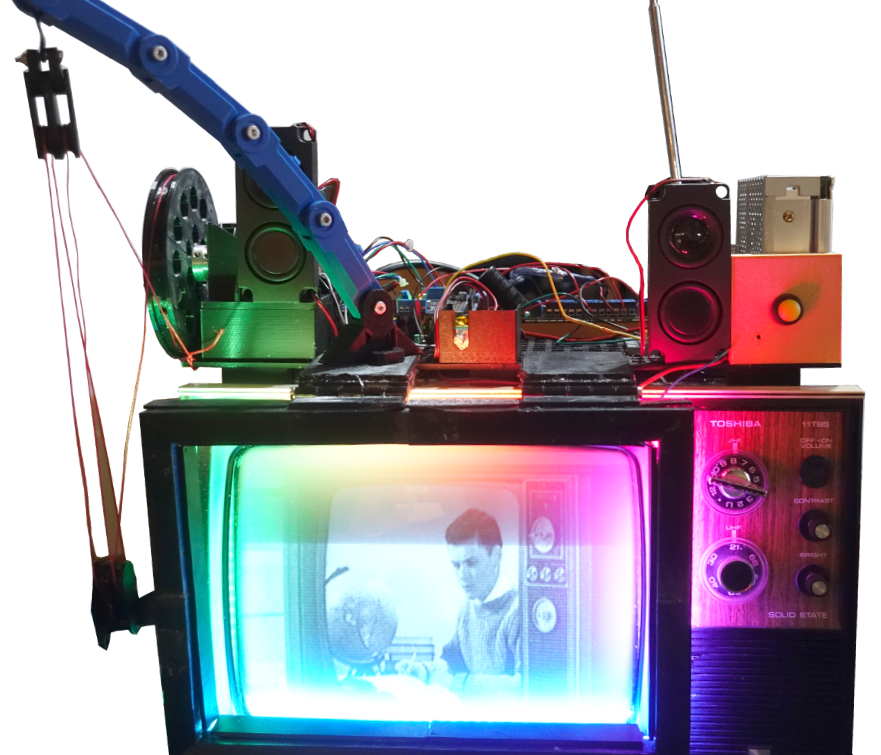
Das Objekt „NTSC“ besteht aus einem Toshiba-„Campingfernseher“ (der aus einer 12V-Autobatterie betrieben werden konnte) sowie aus einem selbst konstruierten 3D-gedrucktem Rahmen, in den einzeln ansteuerbare LEDs eingelassen sind, die bei entsprechender Programmierung ein mit viel gutem Willen als mehrfarbig gelesenes Bild erzeugen können. In den 1970ern gab es Farbfolien zu kaufen, die man vor die Schwarzweiß-Bildröhre klebte, das sah dann etwa so aus:
The NTSC object consists of a Toshiba „camping TV“ set (that was intended to be supplied by a 12V car battery) and a 3D printed frame housing four lines of individually addressable color LEDs. These LEDs, when programmed according to the picture being visible on the screen, can evoke the impression of a tinted b/w image. Back in the 1970s, tinted transparency foils were available, serving the same purpose. Obviously, the example shown below may be suitable for a Western movie with blue skies on top, sandy ground below, and horses and humans in the center. The match with this Star Trek scene leaves a lot to be desired…
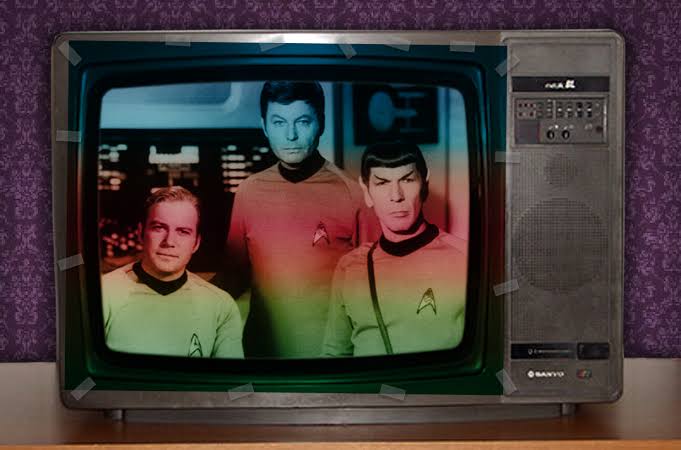
Tja, bei einem Bild aus „Bonanza“ hätte es vielleicht gepasst – die grüne Weide, die braun-rosa Pferde und Cowboys und darüber der blaue Himmel 🙂
„NTSC“ treibt diesen zum Scheitern verurteilten Ansatz auf die Spitze, indem ein etwa dreieinhalb Minuten langes S/W-Video (lauter Musikstücke, die etwas mit Farben zu tun haben) „passend“ (wie gesagt, mit viel gutem Willen…) eingefärbt wird. Die martialische Robotik auf dem TV-Gerät dient zum Runter- und Hochklappen des Farbrahmens. Nicht notwendig, aber eine nette Fingerübung in 3D-Druck und Mikroprozessorsteuerung.
The NTSC object takes this failed approach one step further. A video (3.5 minutes) plays excerpts from songs having to do with color. The LED frame, painstakingly programmed down to fractions of a second, provides color changes in sync with the b/w scenes displayed.
But why the somewhat ludicrous robotics to move the LED frame down and back up again? No particular reason – just because I can. A nice little exercise in 3D printing and microprocessor programming.